Sunday, March 19, 2017

KICK THE BUCKET LIST: MAKING EACH MOMENT A MONUMENT


The BUCKET LIST is a checklist of things a person wants to do before “kicking the bucket.” To “kick the bucket” means to die.  To KICK THE BUCKET LIST means to get rid of the bucket list.

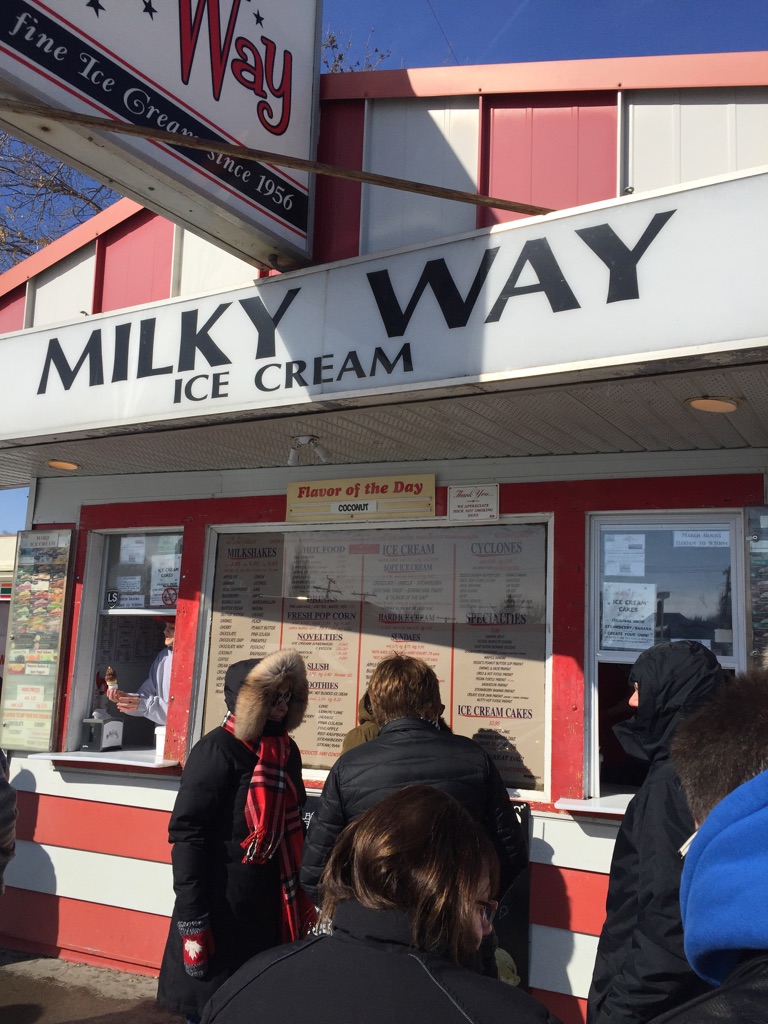
Running a marathon; climbing a mountain; setting foot on different continents; these are some of the so-so activities people commonly pencil on their bucket lists.  Standing in line at Milky Way in minus 20 degree weather was not on my bucket list. (See the picture left.)

KICK THE BUCKET LIST:  MAKING EACH MOMENT A MONUMENT.  Thinking about this topic I’m convinced that making the moments count is much more important than actually seeing the monuments. Life unfolds moment by moment, not monument by monument. Oftentimes, however, we fritter these moments by dwelling on the past, worrying about the future.  And for most of us, we see monuments only on annual vacations.

Life turbulence and chaotic relationships tend to force disconnects within ourselves on a daily basis.  To focus on the present for even a few minutes is a struggle.  Living in the now is enlightenment.  Enlightenment isn’t necessarily one moment in time, rather it is a space of times stretched into meaningful and thoughtful activities.  Living in the now heightens all the senses, hence heightens life. 

Factoid:  Lots of the people I know (most of the people I know) live in big boxes in the burbs and moil in little cavities in their workdays. To be arrogantly judgemental, they are hardly living.  Such living is mindless existing; enlightenment just isn’t happening.

When we are mindless we are missing in action in our own life.  Automaticity, that act of being perfunctory, driving to and from work is just one example.  Missing in action all day long is living like a zombie (pun intended).  

Most of us live in capsules.  Cars; offices; elevators; rooms; we go from one capsule to the next” (John Kim, The Angry Therapist, 2017). 

Little wonder I find great joy walking near water and hiking in mountains.  Rather than capsule to capsule, I tend to go for seasonal diversions.  Spring and summer busking; summer hiking; winter pond hockey; autumn after-gig brews with my buddies; moments as these take on great significance, in the cliché sense that during such moments LIFE DOES NOT GET ANY BETTER THAN THIS.  If one could only stop the clock and freeze the play in such moments.  

Ah!  Savoring a moment!  Ah!

Savoring moments is not without literary and philosophical and historical significance;  ZEN, CARPE DIEM, and MINDFULNESS, especially stay in mind (pun intended again).

  • ZEN

ZEN emphasizes rigorous self-control, meditation-practice, and the personal expressions of daily life.  Zen teachings can be likened to the finger pointing at the moon. 

 THE SELENOPHILE

The moon in the afternoon belongs to my son.
He looks at it and laughs.
It used to belong to me, but at night I never laughed.
(THE MOON IN THE AFTERNOON, one of my many unpublished poems.)

Not-so-strangely, I know not one person who practices the way of Zen. 

Factoid:  Most of the people I know are not even aware of Zen (I am so full of puns today).

Learn to savor the flavors of the present.  Practice seeing and experiencing things for the first time.  Take in not only the sights, but the scents and sounds and feel the presence in each. Zen is Lucy in the Sky.  If you can constellate the Zen moments, you will have a Zen diamond life.

  • CARPE DIEM

CARPE DIEM can mean seize the day (for most people) or grasp the day (for English Literature majors like myself) or pluck the day (for the Latin purists). 

I’ve written lots on Carpe diem.  See WHERE YOU ARE IS WHERE IT’S AT:  AN ESSAY ON CARPE DIEM, EXISTENTIALISM, PHENOMENOLOGY, AND BUSKING (DECEMBER 05, 2010).  Alongside my favorite road theme writings, Carpe diem comes in a close second.

  • MINDFULNESS

MINDFULNESS is the psychological process of bringing one’s attention to the internal and external experiences occurring in the present moment.  Popular culture now attributes mindfulness as being directly connected to greater well-being and good physical health.  In my community, strangely, it seems to be promoted mainly (only) through female counselors and school teachers.

In life I love the Zen theme.  In literature I love the Carpe diem theme.  As for bandwagons, Mindfulness is definitely the current theme rolling by, but I’m not jumping on it … yet.

Back to bucket lists:  Machu Picchu; Petra; the Great Pyramid of Giza; the Great Wall of China; the Colosseum; the Taj Mahal.   These are the monuments that people read and dream about and scribble onto their bucket lists.  However, as for the monuments, getting to and fro and the moments betwixt, are the real adventures in life.  Simply standing amongst a group of tourists and snapping a few photos is hardly an experience worth writing about.  I mean, really, one can at least attempt to experience any particular moment; however we all know because of family budgets, there are few opportunities, for most of us, to see world monuments.

What Stops You is a Zen photography tactic for taking the right pictures. A little angst and a little adventure make up the many moments that can stop a person, the moments that stop the clock so to speak.

Meanwhile, buskaroos …

Each buskspot is a mise-en-scene in the making, and each buskingdom is not necessarily a moment to remember, but certainly a moment to experience.  Monuments are few and far between; whereas, moments are forever present.  Moments are the continuous links from cradle to grave (I apologize for the cliché).  Learn to get lost in the moment.  Learn to forget your watch and enjoy the flow.  Enjoy the flow; stop the clock.

Living in the moment is not without paradox.  Overthinking, that process of self-evaluation, can either be self-deprecating or delusional, of both.  Just know that a waste of time is a waste of life.  If you footle your time you stay the fool. 

Dance the maxixe on each and every moment.  Find something that brings you pleasure and concentrate on it, sketching, bird watching, playing a musical instrument.
Enjoy the entire enterprise in your moments of pleasure from beginning to end, and the beginning should be just as pleasurable as the end.  This kind of focused pleasure is flow.

Some candies to crunch on:

“Now!  It is the most important time because it is the only time we have any power” (Leo Tolstoy).
Forever is composed of nows.  Life is a succession of moments  (Emily Dickinson).
Let us not look back in anger, nor forward in fear, but around in awareness” (James Thurber).
The past is over and the future is not guaranteed” (Wayne Dyer).
The past and future are real illusions” (Alan Watts)
Know that the distinction between past, present, and future is only a stubbornly persistent illusion” (Albert Einstein).
Life is what happens to you while you’re busy making other plans” (John Lennon)

Pining for the past and having angst for the future means missing the present.  Keep your thoughts with your feet.  Focus where your feet are.  Where you are is where it’s at!

Making each moment count is my best friend, Colby Williams, who is still skating in my CHAUCERIAN PARADE:

#25

Sunday, March 5, 2017

SHOULD I OR SHOULD I NOT: EXISTENTIAL DREAD AND THE FINE ART OF CLIFF HANGING


EXISTENTIAL = EXISTENCE + ESSENCE … Hence, existentialism concerns the essence of being alive.  Some examples of existential questions:
What is the meaning of life?  How should I live my life?  Should I work or should I play?  Should I go or should I stay?  Should I kill myself or have another cup of coffee?  

(This last question ... some existential humor ... I guess you had to be there:)

And some more:  Are you bored with your job?  Are you bored with your social status?  Are you bored, in general, with your life?

Most of us go through our vanilla days/daze simply existing.  We go to work and we come home and we deliver to ourselves anodyne moments by watching television, drinking beer, and eating chips.  Sometimes we actually socialize, joining our closest friends, by moving the same activities to a more sociable setting, to another anodyne space, the pub.

Some of us really do lead accursed lives, designing our lives to be soooo routine.  And soooo, why do we routinze ourselves into cages, without exploration or challenges or new ideas.  Why do we choose, instead, to prefer being non-stiction prisoners caged in our own designs.

 
Being a prisoner in a cage is being devoid of the myriad experiences life has to offer.

Despite all my rage, I’m still just a rat in a cage (Smashing Pumpkins song –Bullet With Butterfly Wings) expresses this universal archetype of powerlessness and frustration.


Our choice (free will) seems limited to caging ourselves emotionally and behaviorally and living every day same ol’ same ol.’

Saying thus and living thus, a day will come when we realize the surface meaning of our lives is stripped away and presented with tragedy or a separation.  When someone we love leaves or something interrupts our daily routine, our normal identity is challenged.  When this occurs we experience EXISTENTIAL DREAD, that negative feeling arising from the experience of having the freedom and responsibility of being human.  (EXISTENTIAL DREAD ... Do you enjoy this phrase as much as I do?) 

In any crisis, we as the protagonists in our lives, will one day realize that it is we, alone, who must choose and enact the answers to our own questions. 

When we are in precarious or difficult dilemmas, suddenly, we find ourselves confronted with a shocking revelation (epiphany): That the uncertainty of what lies ahead with the necessity of making a choice and having the responsibility of making that choice that create what is called as Existential Dread.  Existential Dread comes from the responsibility of choice.


Existential dread is that feeling of hanging on a cliff.  Most of us have mastered this procrastination of sorts into a science for fine art.    Should I or should I not (jump).  A fortunate few of us do let go and …


 As a provocateur-projective psychologist, let me ask you:
What is your dream? Are you living it?  What is keeping you back?

Each of us has an inner critic.  Don’t try to reason with it.  Our inner obstructionist keeps us from our dreams (Diane Dreher, Psychology Today, February 03, 2017).

There is within each of us a desire to move forward searching for adventure and fun, and yet we are always putting on the brakes in order to disfavor ourselves. We are never ready … We are never worthy … Never do most of us live our dreams.

Be bored or search for adventure, this is a matter of choice; abandoning boredom is not easy. 

Factoid:  It’s always easier not to (fill in the blank for any imagined activity)!

IN ORDER TO LIVE FREE AND HAPPILY, YOU MUST SACRIFICE BOREDOM.  IT IS NOT ALWAYS AN EASY SACRIFICE. (RICHARD BACH)

Marching in my CHAUCERIAN PARADE this week:

SELF:  BUSKING AT VALUE VILLAGE ZERO DEGREES YESTERDAY

COLBY WILLIAMS (MY BEST FRIEND) JUST SIGNED AN NHL CONTRACT WITH THE WASHINGTON CAPITALS


Monday, February 27, 2017

STATE OF PLAY: FREE WILL OR FREE TIME


IVIKA AND PETER, SLOVAKIAN BUSKERS

Freedom’s just another word for nothin’ left to lose/
Nothin’ ain’t worth nothin’ but it’s free” (from Kris Kristofferson’s song, Me and Bobby McGee).

Life, Liberty, and the pursuit of Happiness is a well-known phrase in the United States Declaration of Independence, and the general theme for this particular blog entry.

The pursuit of Happiness is to me, the pursuit of positive experiences (is to me) to achieve more happiness in life.

Playing electronic and video games, watching television, reading, going for coffee, going for beers, are some popular pastime pursuits enjoyed by Western consumers.

The reason we engage in such pursuits is because we want to.  Such choices are our choices, exercises of our free will.  (When we are forced into doing things, these experiences then are not as positive, maybe even negative.)

Attempting to make the world fit OUR desires is called Primary Control.  Anytime we try to force the world into our personal agenda is most often a futile exercise in control, resulting in a certain dissonance.   

Learning the flexibility of controlling our actions to our experiences is called Secondary Control.  Being flexible in the circumstance is a worthwhile exercise in harmonically going with the flow.
Secondary Control is the true test to adjust to uncontrollable situations.  Having secondary control is having PERSONAL POWER, or in other words, FREE WILL.

Having positive personal power, though, demands thought and action. 
First, we must be aware of the times when we are not in control.  (Consider such times as happy accidents, or random luck.)  For more personal enjoyments, try to always engage in the not-in-control experience.  Positive benefits will always enrich the experience.  Laugh and enjoy the moment, be it by your design or not.

Here is the lesson:  Real personal power demands that you evaluate your life carefully and always attempt to appreciate and enjoy the experience.

Freedom’s just another word for nothin’ left to lose/ Nothin’ ain’t worth nothin’ but it’s free.”  When you’ve nothing to lose – you can do whatever you please.  Nothing left to lose is a rather anti-consumerism expression:  OUR THINGS OWN US.

This brings to mind explanation of my snappy title, STATE OF PLAY:  FREE WILL OR FREE TIME.
First there is my pun on play, as in romp or strum.  Recreation (synonym for play) can be the constructive use of our free time, free, being another pun.

Free can mean from obligation, or free as in a dollar value.  If free is interpreted as a perceived leisure, then free means an intrinsic motivation of sorts.

Free offers three levels of connotation and inference; first as in time, second as in activity, and third as in a state of mind. 

I’m presenting so far that our values of free time could very well be a time versus money dilemma.  This dilemma, measured according to money, offers only the visceral heart vs head, zero-sum solution.

Or the value of free time could be a social value, the construct allocation of time (and money) to another person, or other people, volunteerism (coaching) for example.

Or the value of free time could be recreational value, the construct activity done for enjoyment, amusement, pleasure, or in a word … FUN.

NINE-BALL: BEST GAME EVER (FOR ME)
In my free time I watch CNN for twenty minutes every day on television, just to catch up on the national news, expecting any day now to discover that our obsessed birther, Don Trump, was actually born in Russia and is now a mole serving the Soviet regime.  In my free time I read Psychology Today, Huffington Post, and Al Jazeera news, every morning at 5 o’clock a.m. while I sip my Americano coffee.  In my free time my zeitgeber every morning betwixt 5:30 and 6:00 I go the gym for a weightlifting workout.  In my free time I take Muay Thai on Monday evenings.  In my free time I write in delusional earnest, books that are soon-to-be best sellers and my weekly blog, the one you’re reading right now.  In my free time I play guitar, either busking or gigging or both.  In my free time I go downtown to watch and support my guitar buddies playing live in the downtown pubs.  In my free time I play nine-ball every Saturday afternoon.  All these mentioned activities are intrinsically motivated – all these activities are for me … FUN.

AMERICANO COFFEE: BEST DRINK EVER (FOR ME)
Freedom’s just another word for nothin’ left to lose.
As long as we have something to lose, our actions are constrained by our need to protect it. 

MUAY THAI:  BEST MARTIAL ART EVER (FOR ME)


Here is what I know:
TRUE FREEDOM COMES FROM HAVING NOTHING LEFT TO LOSE  …

WHATEVER YOU DO TO WIMPLE YOUR FREE TIME SHOULD DEMONSTRATE LOVING YOURSELF.